
How much vitamin D do you get from the sun?
The worry behind this search is usually simple: am I getting enough vitamin D, especially if I have deeper skin or wear SPF every day? The plain answer: deeper skin does make less vitamin D per minute of sun, but daily sunscreen almost never causes deficiency, and a blood test, not a guess, settles the question. Here is how it works, a by-type sense of timing, and when a supplement makes more sense than the sun.

If you have ever searched "how much vitamin D from the sun," you have probably found a tidy answer like "10 to 15 minutes a few times a week." It is a comforting number. It is also, for a lot of people, wrong, because that figure quietly assumes fair skin, strong sun, and a fair chunk of bare skin. Change any of those, and the real answer moves a long way.
The single most under-discussed variable is your Fitzpatrick skin type. The amount of melanin in your skin, the thing the Fitzpatrick scale is really tracking, has a direct and large effect on how much vitamin D a given dose of sun produces. This page walks through why, gives you a realistic by-type sense of it, and is honest about the trade-off with sun damage. One thing up front, and repeated below because it matters: this is general education, not medical advice, and definitely not a dose. Only a blood test and a doctor can tell you your own vitamin D level.
How your skin makes vitamin D from sunlight
Vitamin D is a little unusual among vitamins, because your body can manufacture it rather than only eat it. The factory is your skin, and the trigger is a specific slice of sunlight: UVB, the shorter-wavelength ultraviolet that also happens to be the part that burns.
The chemistry is simpler than it sounds. Your skin holds a cholesterol-like molecule (7-dehydrocholesterol). When UVB photons hit it, they convert it into a pre-vitamin, which your body then finishes into the active vitamin D your bones, muscles, and immune system rely on. No UVB, no skin-made vitamin D. That is why the vitamin D you make from sun swings so wildly with anything that changes how much UVB reaches your skin, including the season, the time of day, how far you are from the equator, cloud, glass, clothing, and sunscreen.
And crucially for this site, it swings with the one thing built into your skin itself: melanin.
Why melanin changes the math
Melanin is your skin's own broad-spectrum sunscreen. It evolved to protect the DNA in your skin cells from UV damage, and it is genuinely good at its job. But it cannot tell the difference between the UVB that harms you and the UVB that makes vitamin D. It filters both.
The practical consequence is that, for an identical amount of sun, higher-melanin skin makes less vitamin D per minute. Researchers have measured this directly. Estimates vary by study and method, but the headline is consistent: people with the deepest skin may need somewhere in the range of three to ten times the sun exposure of very fair skin to make a comparable amount of vitamin D. In one striking experiment, a fair-skinned person saw a large rise in blood vitamin D from a UV dose that produced essentially no change in a person with deep skin over the same time.
This is not a defect in deep skin, and it is worth saying plainly. Deep skin evolved in high-UV regions near the equator, where sunlight is intense year-round and the melanin trade-off makes complete sense: strong protection, and still plenty of vitamin D because there is so much UVB to work with. The mismatch only shows up when that same skin lives somewhere the sun is weak for half the year. Which brings us to the real-world pattern.
Deficiency is more common in higher Fitzpatrick types, and the effect is strongest at higher latitudes. People with Type V and Type VI skin who live far from the equator, in the northern United States, Canada, or northern Europe, are among the groups most likely to run low on vitamin D, precisely because their skin needs a lot of UVB to make enough and there simply is not a lot of UVB available for much of the year. It is a well-documented public-health pattern, not a fringe idea.
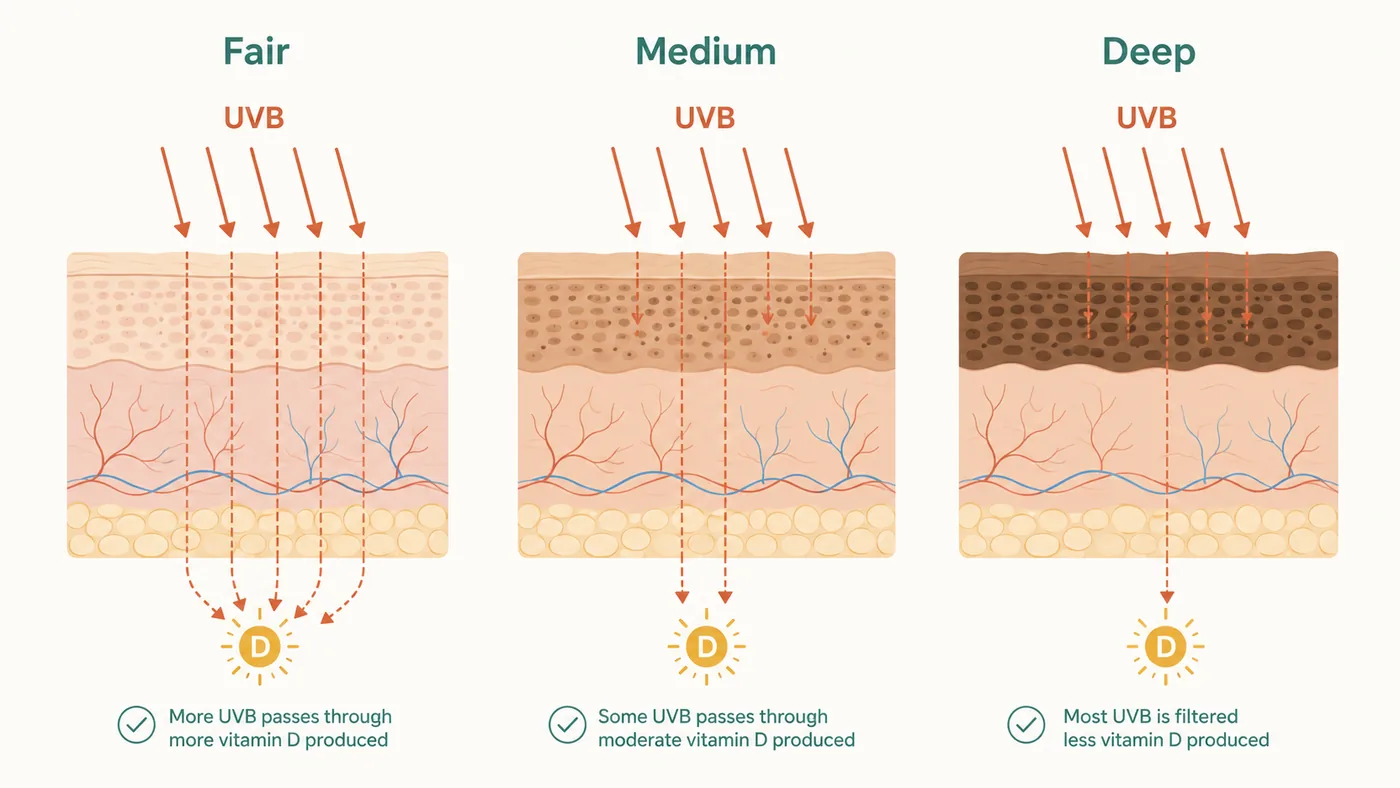
A by-type sense of sun exposure
Here is the careful part. There is no responsible way to give you an exact "you need X minutes" figure, because it genuinely depends on your latitude, the season, the time of day, how much skin is bare, and your own body. So what follows is a relative sense, not a prescription: roughly how the same summer-midday sun treats different skin types, all else equal. Treat it as intuition-building, not a timer.
| Fitzpatrick type | Melanin level | Relative sun needed for the same vitamin D |
|---|---|---|
| Type I to II (very fair to fair) | Low | The least. Makes vitamin D quickly, but also burns fastest, so exposure has to stay very brief. |
| Type III (medium) | Moderate | A little longer than fair skin for the same amount, with more margin before burning. |
| Type IV (olive) | Moderate to high | Noticeably longer than fair skin. Tans readily, so it is easy to under-estimate how long it actually needs. |
| Type V (brown) | High | Considerably longer, often several times a fair person's exposure for the same vitamin D. |
| Type VI (deep) | Very high | The most, up to roughly ten times a very fair person in some estimates. Most prone to running low, especially at higher latitudes. |
The pattern is the point: as you move down the scale, the melanin advantage against sun damage grows, and the vitamin D you get per minute of sun shrinks. That is not a reason for anyone to chase sun, and especially not a reason for fair skin to feel let off the hook, fair skin makes vitamin D fast and burns fast, which is its own risk. It is simply why deep skin cannot rely on the sun the way a "15 minutes a few times a week" headline implies.
Not sure of your type?
All of this hinges on knowing where you fall on the scale. If you are not certain whether you are a Type III, a Type V, or somewhere between, the fastest way to find out is to check. See how to find your skin type for the by-hand method, or take the free Fitzpatrick test to get your type in under a minute.
The other things that change the number
Skin type is the variable this site cares about, but it is not the only one, and ignoring the rest is how "10 minutes" becomes misleading. A few that matter as much or more on any given day:
- Latitude. The further you live from the equator, the weaker the UVB, and for a stretch of winter it can be too weak to make meaningful vitamin D at all, at any skin type. This is why northern winters are the classic deficiency season.
- Season and time of day. UVB is strongest around midday in summer. Early morning, late afternoon, and winter sun deliver far less, even when it feels bright and warm.
- How much skin is bare. Vitamin D is made across whatever skin the UVB reaches. Face-and-hands only makes far less than arms and legs. Clothing, and covering for cultural or personal reasons, reduces production a lot.
- Glass and cloud. Ordinary window glass blocks most UVB, so sun through a window does little for vitamin D. Heavy cloud and pollution cut it too.
- Age and other factors. Skin makes less vitamin D as you get older, and body weight, some medical conditions, and some medications affect your level as well. Another reason a blood test beats a guess.
Stack these up and you can see why a single minute-count can never be right for everyone. A fair-skinned person on a Florida beach in June is in a completely different situation from a deep-skinned person walking to work, mostly covered, in Minnesota in February, even though both are technically "getting sun."
The balance: vitamin D versus skin-cancer risk
Here is the tension at the heart of this whole topic, and the reason dermatologists get uneasy when vitamin D is used as a reason to skip sun protection. The exact rays that make vitamin D, UVB, are also the rays that damage skin-cell DNA, drive photoaging, and raise skin-cancer risk. You cannot fully separate the benefit from the harm; they ride in on the same light.
That does not play out evenly across the Fitzpatrick scale, either. Fairer types burn quickly and carry the highest skin-cancer risk, so squeezing more sun out of them for vitamin D is a bad trade. Deeper types have real melanin protection and burn far less, but the sun still drives hyperpigmentation and uneven tone, the number-one sun concern people with deep skin bring to a dermatologist, and deep skin is not immune to skin cancer either. So there is no skin type for which "just get more sun" is clean advice.
The mainstream medical position resolves the tension in a way that is easy to remember: protect your skin daily, and get vitamin D from diet or a supplement rather than from unprotected sun. You never need to burn to make vitamin D, redness is damage, not a bigger dose, and you do not have to abandon daily SPF to keep your level up. In practice, most people who wear sunscreen are not more deficient, because nobody applies it thickly or evenly enough to block everything, and the small amount of incidental sun everyday life delivers does real work.
The non-negotiable framing
This page is general education about how skin type and sun interact. It is not medical advice, not a diagnosis, and not a dosing recommendation. Vitamin D needs are genuinely individual, and both too little and too much can be a problem. If you are wondering whether you are low, the right move is a conversation with your doctor, who can test your blood level and advise you specifically. Please do not use anything here as a reason to change your sun habits or start a supplement without that conversation.
When a supplement makes more sense than the sun
For a lot of people, and especially for the higher Fitzpatrick types this whole page is about, a supplement is simply the more reliable and safer source of vitamin D than chasing sun. It sidesteps the UV-damage trade-off entirely: you get the vitamin without the DNA damage, the aging, or the pigmentation risk. That is a genuinely good deal.
The groups most often advised to think about diet and supplements rather than relying on the sun tend to include:
- Anyone with deep skin (Type V or VI), whose skin needs a large amount of UVB to make enough, which is hard to get safely at many latitudes.
- Anyone living at higher latitudes, where winter sun is too weak for skin-made vitamin D for months at a time.
- People who are mostly indoors, or who cover up for work, climate, or personal or cultural reasons.
- Older adults, whose skin makes less vitamin D than it used to.
On the diet side, oily fish, egg yolks, and fortified foods (many milks, plant milks, and cereals are fortified) all contribute, though for many people diet alone does not reach an adequate level, which is where a supplement comes in. Vitamin D3 (cholecalciferol) is the common form in over-the-counter supplements. The right amount for you, though, depends on your blood level and your circumstances, so this is a your-doctor question, not a pick-a-number-off-the-internet one.
As an Amazon Associate this site earns from qualifying purchases. The product type below is mentioned only as general context, not as a recommendation to take it; whether you need a supplement, and at what dose, is a decision for you and your doctor. The link opens a search so you see current options.
Questions, answered
How much vitamin D do you actually get from the sun?
It varies enormously, because the sun does not deliver a fixed dose. A fair-skinned person in strong midday summer sun can make a meaningful amount of vitamin D in as little as 10 to 15 minutes of arms-and-legs exposure, while someone with deep skin may need several times longer for the same amount, because melanin filters the UVB that drives the reaction. Latitude, season, time of day, cloud, and how much skin is bare all change the figure too, which is why no single minute count fits everyone. This is general guidance, not a dose; a blood test and a doctor are the only way to know your own level.
Does darker skin make less vitamin D from the sun?
For the same sun exposure, yes. Melanin acts like a built-in sunscreen, absorbing some of the UVB that the skin uses to make vitamin D, so deeper skin produces less per minute of sun. Studies suggest people with the deepest skin may need roughly three to ten times the exposure of very fair skin to make a comparable amount. It does not mean deep skin cannot make vitamin D, only that it takes longer, which is one reason deficiency is more common in Type V and VI skin, especially far from the equator.
How long should I stay in the sun to make vitamin D?
There is no safe universal number, because it depends on your skin type, the latitude, the season, and the strength of the sun that day. As a rough sense, fair skin may need only short, single-digit-to-15-minute midday exposures, medium skin somewhat longer, and deep skin considerably longer. The important part is that you never need to burn to make vitamin D; redness means damage, not more vitamin D. Brief, regular, non-burning exposure is the idea, and for many people a supplement is a simpler and safer route than chasing sun.
Does sunscreen stop you making vitamin D?
In theory sunscreen blocks some of the UVB that makes vitamin D, but in real life most people apply too little, too unevenly, and reapply too rarely for it to wipe out production, and studies generally find that regular sunscreen users are not more deficient. Dermatologists overwhelmingly advise keeping up daily sun protection and getting vitamin D from diet or a supplement rather than from unprotected sun, because the skin-cancer and aging cost of extra UV is not worth the trade.
Should I take a vitamin D supplement instead of relying on the sun?
For many people, especially anyone with deep skin, anyone living at higher latitudes, and anyone who covers up or stays mostly indoors, a supplement is the more reliable and safer source than sun exposure. It removes the UV-damage trade-off entirely. But dose is individual and depends on your blood level, so this is a conversation to have with a doctor, who may test your level first. This page is educational and is not medical advice or a dosing recommendation.
Why is vitamin D deficiency more common in people with deep skin?
Because the same amount of sun makes less vitamin D in deep skin, deficiency is more common in Type V and VI, and the effect is strongest at higher latitudes where the sun is weaker for much of the year. It is a mismatch between a skin type that evolved for high-UV regions and a modern life that is often indoors and far from the equator, not a flaw in the skin. It is also a good reason to consider diet and supplements and to raise vitamin D with a doctor.