
What is the Fitzpatrick scale?
The Fitzpatrick scale sorts human skin into six types, Type I to Type VI, by how it reacts to the sun: how easily it burns and how readily it tans. It is the most widely used shorthand in skin care for one practical question, how much does your skin need to worry about ultraviolet light.
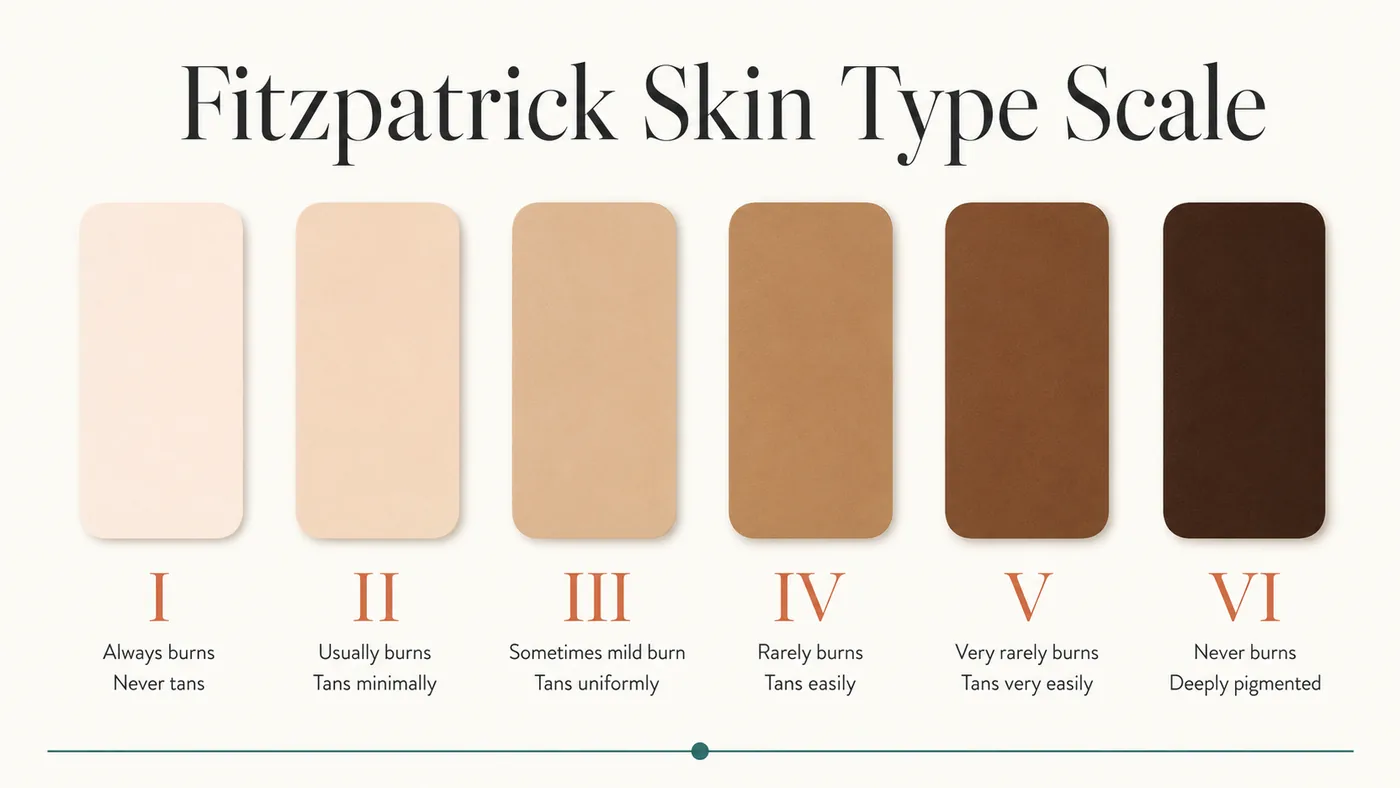
If you have ever read a sunscreen review, booked a laser treatment, or wondered why a friend turns golden in an afternoon while you turn pink, you have brushed up against the Fitzpatrick scale. It is a simple six-point system, and once you know your number it quietly answers a lot of skin-care questions, from which sunscreen will not leave a gray cast to whether self-tanner is the smarter route to color. This page is the full explainer: where the scale came from, what it does and does not measure, the six types in plain language, and how to find yours.
Where the scale came from
The scale is named for Thomas B. Fitzpatrick, a dermatologist who chaired the department of dermatology at Harvard Medical School. In 1975 he needed a practical answer to a clinical problem. Doctors treating skin conditions such as psoriasis with ultraviolet light, including PUVA therapy that pairs a light-sensitizing drug with UVA, had to choose a starting dose. Too little did nothing; too much risked a serious burn. What they needed was a quick way to predict, before the first treatment, how a given patient's skin would respond to UV.
Fitzpatrick's answer was elegantly low-tech. Rather than measure pigment in a lab, he asked patients to report their own history: did their skin burn, tan, or both, when exposed to strong sun. From those answers he sorted skin into types. The original 1975 version had only four, covering the range of lighter, typically white skin that the phototherapy question was first concerned with. As the system spread beyond that narrow clinical use, it was expanded, and by the late 1980s it carried the six types we use today, adding Type V for brown skin and Type VI for deeply pigmented Black skin.
That origin still shapes everything about the scale. It was designed to predict a sun reaction so a treatment could be dosed safely, and that is the job it does best. The same logic that once set a phototherapy dose now sets your sunscreen strategy.
What it actually measures
The Fitzpatrick scale measures exactly two things, and it is worth being precise because almost every misunderstanding of the scale comes from forgetting this:
- Burn tendency. How easily and severely your skin burns when it gets too much sun. Type I burns within minutes; Type VI rarely burns at all.
- Tan ability. How readily your skin develops a tan afterward, and how deep that tan goes. Type I produces almost no tan; the deeper types tan easily and hold it.
That is the whole of it. The scale is built from the things your skin does in the sun, supported by a few genetic clues, your natural eye color, your natural hair color, the color of skin the sun never reaches, and how much you freckle, that correlate with that behavior.
Just as important is what the scale is not. It is not a beauty ranking; a higher or lower number is not better or worse. It is not a measure of race or ethnicity, even though the types loosely track ancestry, and treating it as a race label is exactly the kind of mistake that gets the scale criticized. And it is not a precise readout of your skin's shade. It is one narrow, useful thing: a prediction of how your skin handles ultraviolet light.
The six types, one by one
Here is the whole scale in brief. Each type links to its own guide with the full routine, product types, and common mistakes. If you want them side by side instead, the Fitzpatrick type chart lays out all six by burn, tan, and SPF.
Type I, very fair
Pale or porcelain skin that always burns and effectively never tans. Often paired with light eyes and red or blonde hair, and frequently freckled. This is the highest-risk type for sunburn and sun damage, so the routine is built around maximum daily protection, with self-tanner doing the work that the sun cannot do safely. Read the full Type I guide.
Type II, fair
Fair skin that usually burns and tans only lightly. It will build a faint tan, but it burns first and pays for the color. High daily SPF plus a gradual self-tan is the smart combination. See the Type II guide.
Type III, medium
Medium skin that sometimes burns, then tans gradually to a light brown. This is the middle of the scale, and the practical theme is daily SPF plus keeping tone even as the first uneven patches can appear here. See the Type III guide.
Type IV, olive
Olive or light-brown skin that tans easily and rarely burns, usually with a warm, golden undertone. The concern shifts from burning to dark spots and uneven tone, so a no-white-cast sunscreen and gentle brightening matter more than raw burn protection. See the Type IV guide.
Type V, brown
Brown skin that rarely burns and deepens readily in the sun. The main issue is hyperpigmentation, dark spots that linger after a blemish or sun exposure, so an invisible, no-cast SPF and consistent, gentle care for even tone are the priorities. See the Type V guide.
Type VI, deeply pigmented
Deeply pigmented skin that effectively never burns. The persistent myth that this type does not need sunscreen is wrong: deep skin is still affected by ultraviolet light, mostly through hyperpigmentation and uneven tone, and a zero-cast SPF that disappears on the skin is the single most useful product. See the Type VI guide.
A quick note on the Roman numerals
The types are written with Roman numerals, Type I through Type VI, because that is how Fitzpatrick set them out and how clinical literature still refers to them. Plenty of everyday writing uses 1 to 6 instead, and they mean the same thing. We use the Roman numerals throughout this site to match the source.
How to find your type
Finding your type is a self-assessment, the same kind Fitzpatrick used. You answer questions about your features and, more importantly, about how your skin actually behaves in the sun. There are two ways to do it on this site:
- Take the test. The fastest route is our free Fitzpatrick skin type test. It asks eight short questions, scores them the way the scale is built, and returns your type with a routine and product picks. Nothing is stored and there is no email to give.
- Do it by hand. If you would rather understand the logic, our how to find your skin type guide walks through the burn-history method step by step, so you can reason your way to a type and sanity-check the test's result.
One tip that makes the answer far more reliable: assess your natural, unexposed skin, the way you look at the start of summer, not mid-tan. A current tan can push your skin a type or two darker than its baseline, and the scale is meant to describe your baseline.
Type versus skin tone
This is the distinction people trip over most, so it earns its own section. Your skin tone describes how your skin looks: its shade and undertone, the thing a foundation has to match. Your Fitzpatrick type, sometimes called your phototype, describes how your skin behaves in ultraviolet light: how it burns and tans.
They usually line up. Fair skin tends to be Type I or II, deep skin tends to be Type V or VI. But they are not the same axis, and the gaps are where the scale earns its keep. Two people with a very similar tone can sit on different types because one burns and the other tans. Someone with a medium tone but a strong family history of burning may behave more like a Type II than their shade suggests. The type captures the behavior; the tone captures the look. When you are choosing sunscreen, the behavior is what matters.
Why it matters for sun care and products
Knowing your type is not trivia. It is the fastest way to stop guessing at the shelf, because each type has a different sun-care problem to solve:
- The fair types (I and II) need maximum, daily, broad-spectrum protection, often backed up with UPF clothing and shade, and they get color from self-tanner rather than the sun.
- The middle types (III and IV) still need daily SPF, but their second job is keeping tone even, choosing a sunscreen that does not cast gray and adding gentle brightening as needed.
- The deep types (V and VI) burn rarely but are very much affected by the sun through hyperpigmentation, so the wedge is an invisible, zero-cast SPF and steady care for even tone and dark spots.
That is why this site organizes its buying guides around the problem, not the brand: sunscreen for dark skin and sunscreen for brown skin for the no-cast question, foundation for olive skin for the matching question, and self-tanner for pale skin for the color-without-burning question. Your type tells you which of these is yours.
Beyond products, the scale carries real clinical weight. Clinicians use it to set starting doses for laser and light-based treatments, to gauge how a skin might respond to chemical peels, and as one factor when thinking about sun-damage and skin-cancer risk. That is the same predictive job it was invented for in 1975, applied across modern dermatology.
Limitations and honesty
The Fitzpatrick scale is useful, and it has real limits worth stating plainly.
It is an estimate, especially online. A self-assessment, including our test, depends on how well you read your own skin. It gives a reliable working estimate for choosing sun care, but it is not a lab measurement and it is not a diagnosis.
It was built around fair skin. Because the original four types covered lighter skin, the scale is less precise at the deeper end, where burning is rare and the more relevant question is pigmentation. Researchers have cautioned that a low burn risk for Types V and VI can create a false sense of security, when deep skin still needs sun protection and is still affected by sun damage. If you are at the deeper end of the scale, treat the low burn score as one fact among several, not a green light to skip sunscreen.
It is sometimes misused as a race label. The types loosely track ancestry, but the scale measures sun reaction, not ethnicity, and using it as a stand-in for race is a recognized misuse. Stick to what it actually measures.
When to see a professional
This page and this site are educational. The Fitzpatrick test is a guide for everyday sun care, not a medical diagnosis. If you have a changing mole, a spot that will not heal, a strong personal or family history of skin cancer, or you are planning a laser, peel, or other medical treatment, see a board-certified dermatologist, who can assess your skin in person and decide what is right for you.
None of these limits make the scale less worth knowing. They just mean you should treat your type as a smart starting point: accurate enough to choose better sunscreen today, and a sensible thing to confirm with a professional when the stakes are higher.
Ready to find yours? Take the free Fitzpatrick test, it takes under a minute and nothing is stored.
Sources
- Fitzpatrick TB. The validity and practicality of sun-reactive skin types I through VI. Archives of Dermatology, 1988.
- American Academy of Dermatology, sunscreen FAQs.
- Skin Cancer Foundation, skin cancer in people of color.
Common questions
What is the Fitzpatrick scale in simple terms?
The Fitzpatrick scale is a way of sorting skin into six groups, called types or phototypes, by how it reacts to sun. Type I always burns and never tans, Type VI effectively never burns and is deeply pigmented, and the other four fall in between. It describes how your skin behaves in the sun, not how it looks or what race you are.
Who created the Fitzpatrick scale and when?
The dermatologist Thomas B. Fitzpatrick developed it at Harvard in 1975 to help predict how a person's skin would respond to ultraviolet light during phototherapy, so doctors could dose treatment safely. It originally had four types and was later expanded to six to include brown and Black skin.
What does the Fitzpatrick scale actually measure?
Two things: how easily your skin burns in the sun, and how readily it tans afterward. It does not measure beauty, ethnicity, or the exact shade of your skin. Two people with a similar tone can land on different types because they burn and tan differently.
How do I find my Fitzpatrick skin type?
Answer a short set of self-assessment questions about your eye color, natural hair color, the color of skin the sun never reaches, your freckling, and how your skin burns and tans. You can take our free test, which scores those answers, or read the manual burn-history method to check it by hand.
Is the Fitzpatrick scale a medical diagnosis?
No. It is an educational classification that gives a useful estimate of how your skin reacts to sun, and clinicians use it as one input when planning light-based treatments. It is not a diagnosis, and a self-assessment online is an estimate. See a dermatologist for any skin concern or before any medical treatment.
Does the Fitzpatrick scale work well for dark skin?
It is a useful starting point for everyone, but researchers note it was built around fair skin and is less precise at the deeper end, where the main concern is hyperpigmentation rather than burning. Deep skin still needs daily sun protection, and Types V and VI should not read a low burn risk as a reason to skip sunscreen.
Keep reading
Not sure which type you are?
The scale makes a lot more sense once you have your own number. Take the free Fitzpatrick test and get your type, a routine, and picks that fit, in under a minute.
Take the Fitzpatrick test →