
The Monk Skin Tone scale vs the Fitzpatrick scale
One scale describes how your skin looks. The other describes how it reacts to the sun. Here is what the 10-shade Monk Skin Tone scale actually is, how it differs from the six-type Fitzpatrick scale, where each one is used, and which to reach for depending on what you are trying to do.
The quick answer
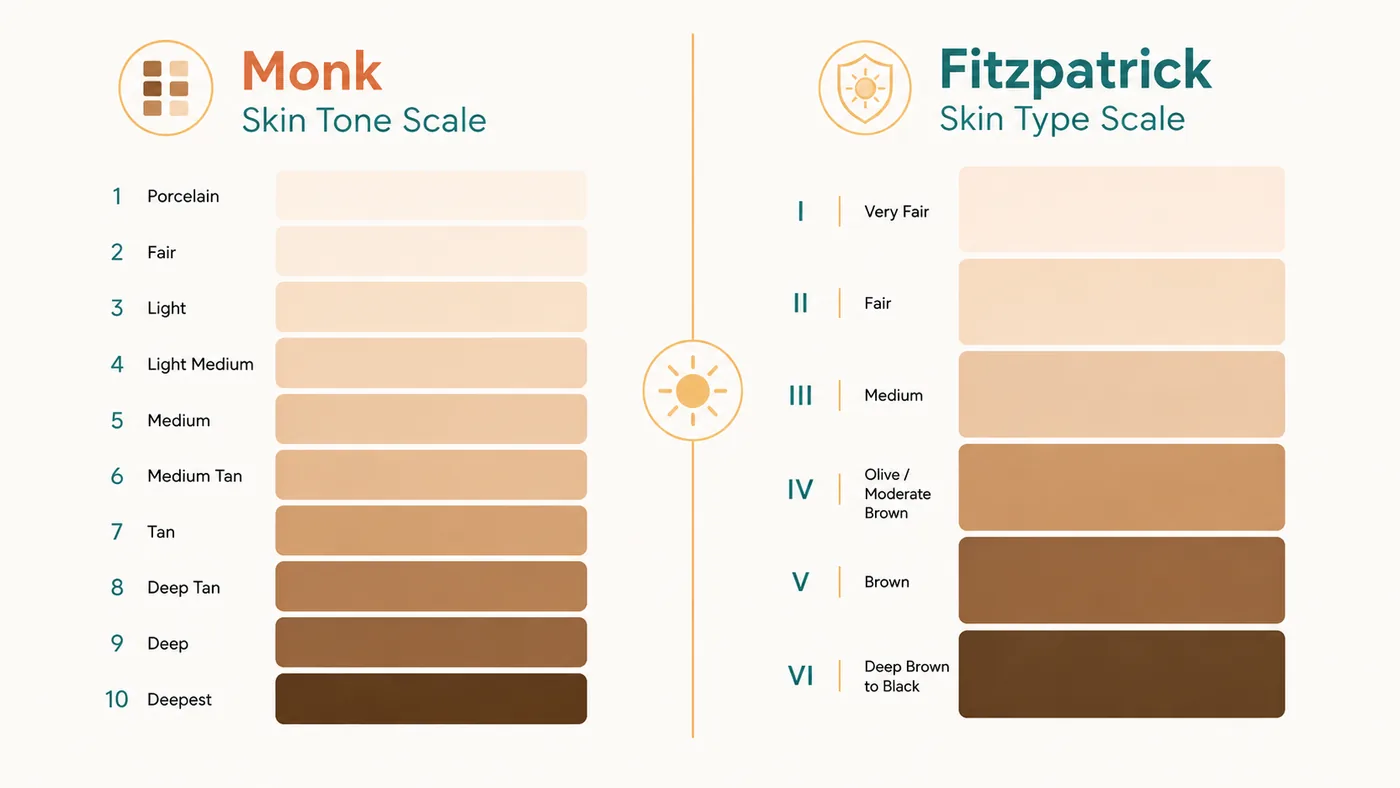
If you only remember one thing, remember this: the Fitzpatrick scale describes how skin behaves; the Monk Skin Tone scale describes how skin looks.
The Fitzpatrick scale, from 1975, sorts skin into six phototypes (the clinical term for skin type) by how easily it burns and tans in the sun. It is a sun-reaction and dermatology tool. The Monk Skin Tone scale, released publicly with Google in 2022, is a 10-shade reference of skin color from lightest to deepest. It is a representation tool, built so that cameras, algorithms, and beauty shade ranges treat every tone fairly, especially deep tones that the older scale handled poorly.
They are not rivals so much as two instruments for two different jobs. You would use Fitzpatrick to choose sunscreen or judge burn risk. You would use Monk to describe or match a tone. Below is the full picture, in plain language.
What the Monk Skin Tone scale is
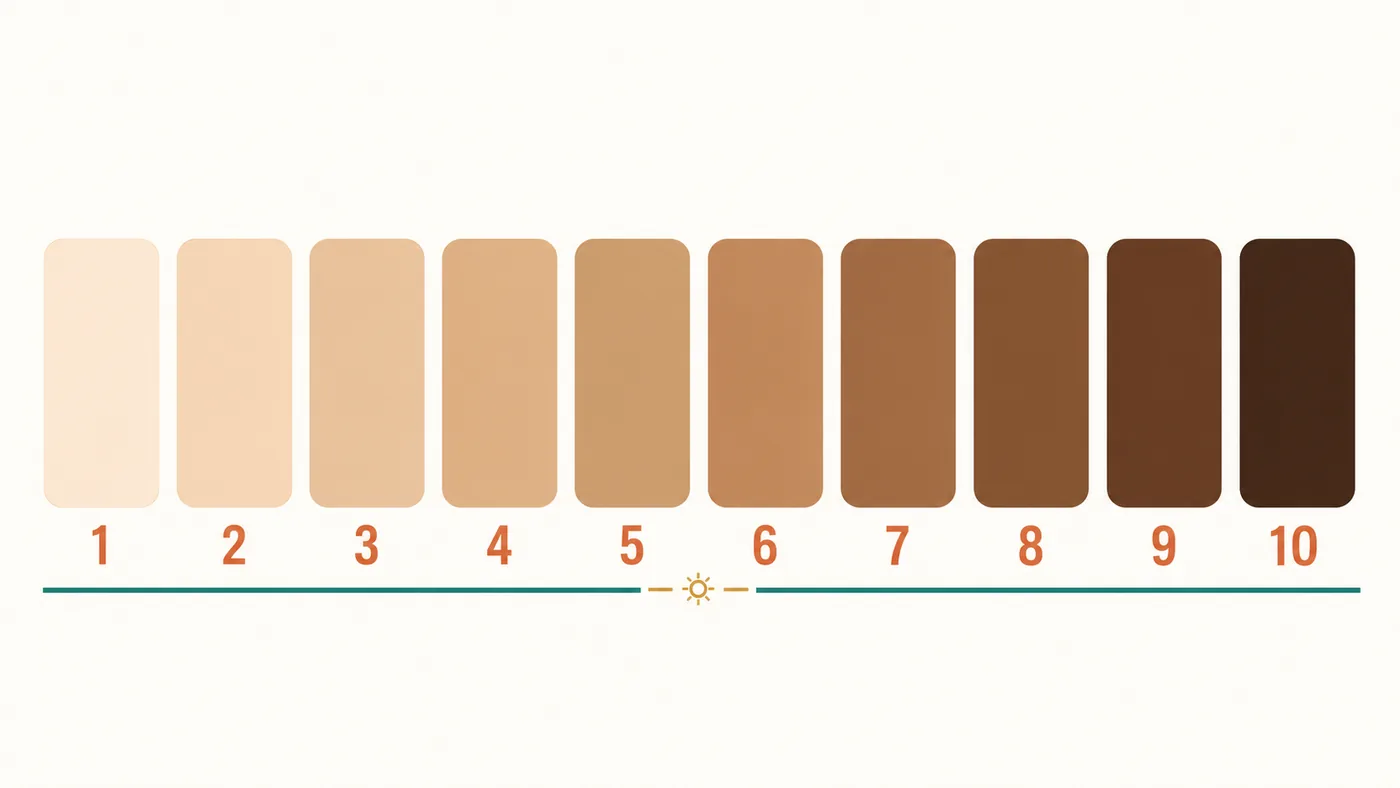
The Monk Skin Tone scale, usually shortened to MST, is a set of 10 skin-tone swatches running from the lightest to the deepest, meant as a visual reference anyone (or any camera, or any algorithm) can use to label a skin tone. Think of it less like a diagnosis and more like a paint chip: it names an appearance, nothing more.
It was created by Dr Ellis Monk, a sociologist at Harvard who spent years studying how skin tone shapes real-world outcomes. He designed the scale to be broad enough to represent people fairly, but small enough to stay usable, ten steps rather than a hundred. Google partnered with him and released the scale openly in 2022, publishing it so that anyone building products could adopt it.
The motivation was a practical fairness problem. Many photo and camera tools, search results, and beauty product lines had been quietly built around lighter skin, so they underperformed on deeper tones: filters that washed people out, "nude" ranges that stopped short, search results that returned mostly light skin. A more evenly spaced 10-tone scale, with real representation of deep skin, gave engineers and brands a shared yardstick to check and correct that imbalance.
Crucially, the Monk scale says nothing about how your skin reacts to the sun. It does not predict whether you burn, and it is not a medical classification. It answers one question, "what tone is this skin?", and it answers it more evenly across the deep end of the range than the tool that came before it.
What the Fitzpatrick scale is
The Fitzpatrick scale is the older and more familiar of the two. Developed in 1975 by dermatologist Thomas Fitzpatrick, it sorts skin into six phototypes, Type I through Type VI, based on a completely different question: how does your skin respond to ultraviolet light? Type I always burns and never tans; Type VI is deeply pigmented and effectively never burns.
It was built for a clinical purpose, originally to dose ultraviolet therapy safely, and it is still the working standard in dermatology, laser and light treatments, and everyday sun-care advice. When a sunscreen guide or a dermatologist asks how easily you burn, they are thinking in Fitzpatrick terms, whether or not they name it.
The scale has one well-known weakness, and it is exactly the gap the Monk scale was built to close. Fitzpatrick gives four categories to light skin and only two to the entire range of deep skin, Types V and VI. That is fine for predicting sunburn, where the meaningful differences really do cluster at the lighter end. But it is a poor tool for describing the wide variety of deep tones, because it lumps a huge span of appearances into two buckets.
If you want to place yourself on it, our guide to how to find your skin type walks through the questions, or you can take the free Fitzpatrick test and get your type in under a minute.
The one difference that explains everything
Almost every other contrast between these two scales flows from a single distinction:
Fitzpatrick measures a reaction. Monk measures an appearance.
Because Fitzpatrick is about how skin behaves under UV, it only needs enough categories to capture meaningful differences in burn and tan risk, and those differences are concentrated among lighter tones. Six types does the job. It is a behavior scale.
Because Monk is about how skin looks, it needs to represent the full visible range evenly, including the many distinct deep tones that a behavior scale can afford to collapse. Ten tones does that job. It is an appearance scale.
Once you hold that in mind, the rest falls into place: why Monk has more steps, why it covers deep skin more richly, why tech and beauty adopted it, and why dermatology still leans on Fitzpatrick. They are answering different questions, so they are shaped differently.
A useful analogy
Think of a weather forecast versus a photograph of the sky. Fitzpatrick is the forecast: it predicts what will happen (will this skin burn?). Monk is the photograph: it records what something looks like right now (what tone is this?). A forecast and a photo are both true and both useful, but you would not use one to do the other's job. Reach for the forecast when you are deciding whether to pack sunscreen, and the photo when you are matching a color.
Side by side comparison
Here are the two scales laid out against each other on the points people ask about most.
| Fitzpatrick scale | Monk Skin Tone scale | |
|---|---|---|
| Introduced | 1975, by dermatologist Thomas Fitzpatrick | Released publicly with Google in 2022, created by Dr Ellis Monk |
| What it measures | How skin reacts to the sun (burn and tan) | How skin looks (visible tone) |
| Categories | 6 phototypes (Type I to VI) | 10 tones (lightest to deepest) |
| Coverage of deep skin | Only 2 of 6 categories (Types V and VI) | Roughly half its tones cover the deeper range |
| Type of tool | Behavior / phototype | Appearance / color reference |
| Main home | Dermatology, laser and light treatment, sun care | Technology, cameras, search, beauty shade ranges |
| Predicts sunburn risk? | Yes, that is its whole purpose | No, it does not attempt to |
| Best question for it | "How does my skin behave in the sun?" | "What tone is this skin, and how do I represent it?" |
One more point worth naming, because it comes up often: researchers have found the Monk scale describes the appearance of deep skin far more consistently than Fitzpatrick does, which makes sense given Fitzpatrick was never built to grade color. That is a fairness win for representation. It does not mean Monk is "more accurate" for sun care, because the two are not measuring the same thing.
Where each scale is used
Knowing where you are likely to meet each scale makes the difference concrete.
Where you meet the Fitzpatrick scale
- Dermatology and skin cancer risk. Your phototype helps predict how sun-sensitive you are and how carefully you need to protect and monitor your skin.
- Laser and light-based treatments. Practitioners set energy levels partly by Fitzpatrick type, because deeper skin needs different, safer settings.
- Sun-care advice. Recommendations for SPF strength, reapplication, and whether you need to worry more about burning or about hyperpigmentation all trace back to phototype.
Where you meet the Monk Skin Tone scale
- Cameras and photo tools. Auto-exposure, editing, and filters tuned against a fuller tone scale render deep skin more faithfully instead of washing it out.
- Search and image results. A broader scale lets results represent a wider, fairer spread of tones for the same query.
- Beauty shade ranges. Brands use tone scales to plan foundation, concealer, and "nude" ranges that actually reach the deepest customers, not just the lightest.
- Machine-learning fairness testing. Teams check that a model performs evenly across all tones, using MST as the shared yardstick.
Why both can be true at once
A single person can be Fitzpatrick Type VI and sit at a particular step on the Monk scale, with no contradiction. The Fitzpatrick type says "this skin rarely burns and needs invisible SPF and dark-spot care." The Monk step says "this is the tone, so here is the foundation shade or the camera setting that suits it." One informs your sun-care routine; the other informs how you are represented and matched. Neither cancels the other out.
Which to use, and when
You do not have to pick a side. You pick the scale that fits the question in front of you.
Use the Fitzpatrick scale when the question is about sun and skin health: How strong an SPF do I need? Am I prone to burning? What settings are safe for a laser treatment? Should I worry more about sunburn or about dark spots? These are behavior questions, and Fitzpatrick is the tool built to answer them. If you do not know your type yet, the Fitzpatrick type chart lays all six out side by side.
Use the Monk Skin Tone scale when the question is about appearance and representation: What is my tone, and which foundation or concealer shade matches it? Does this app or camera render my skin faithfully? Is this product range inclusive of deep tones? These are appearance questions, and Monk covers the full range, deep tones included, more evenly.
In practice, plenty of people use both. A common flow is to find your Fitzpatrick type first, so you know how your skin behaves and how to protect it, then use a tone scale like Monk for shade matching. One protects your skin; the other helps you find products that look right on it.
Want your Fitzpatrick type first?
Sun care starts with knowing how your skin reacts, not just how it looks. The free Fitzpatrick test asks eight quick questions and gives you your phototype, plus a sun-care routine chosen for it, in under a minute. From there, a tone scale like Monk is easy to layer on for shade matching.
Questions, answered
What is the Monk Skin Tone scale?
The Monk Skin Tone scale is a 10-shade reference scale that describes how skin looks, from the lightest to the deepest tones. It was created by Harvard sociologist Dr Ellis Monk and released publicly with Google in 2022 to give technology and beauty a more inclusive way to represent skin tone than the older, six-type Fitzpatrick scale, which is weighted toward lighter skin.
How is the Monk scale different from the Fitzpatrick scale?
They measure different things. The Fitzpatrick scale describes how skin reacts to the sun across six phototypes, how easily it burns and tans, so it is a sun and dermatology tool. The Monk scale describes how skin looks across 10 tones, so it is a representation and fairness tool for cameras, algorithms, and beauty shade ranges. Fitzpatrick is about behavior; Monk is about appearance.
Why did Google create a new skin tone scale?
The Fitzpatrick scale has four categories for light skin and only two for the entire range of deep skin, so tools trained on it tended to under-represent darker tones. Google worked with Dr Ellis Monk to adopt a 10-shade scale with more balanced coverage of deep tones, so that search results, camera and photo tools, and shade recommendations would work more fairly across all skin colors.
Does the Monk scale replace the Fitzpatrick scale?
No. The Fitzpatrick scale is still the standard in dermatology and sun care because it predicts burn and tan risk, which the Monk scale does not attempt to do. The Monk scale is now common in tech and beauty for representing appearance. They are complementary: use Fitzpatrick to choose sun protection, use Monk to describe or match a tone.
Which skin tone scale should I use?
If your goal is sun care, skin cancer risk, or a dermatology or laser setting, use the Fitzpatrick scale, because it captures how your skin reacts to UV. If your goal is representing or matching a skin tone, for a foundation shade, a camera setting, or an inclusive product range, the Monk scale describes appearance more evenly across deep tones. Many people find their Fitzpatrick type first, then use Monk for shade matching.
Is the Monk scale used in dermatology?
It is starting to appear in dermatology research as a fairer way to describe skin color, and studies have found it classifies the appearance of deep skin more consistently than Fitzpatrick. But for clinical decisions about sun sensitivity and treatment, the Fitzpatrick phototype remains the working standard, because it describes sun reaction rather than color alone.
Related guides
Sources
- Google, the Monk Skin Tone scale
- Fitzpatrick TB, "The validity and practicality of sun-reactive skin types I through VI," Archives of Dermatology, 1988
- American Academy of Dermatology, sunscreen FAQs
This site is educational and is not medical advice; for any skin concern, see a board-certified dermatologist.